Showing posts with label Bittman. Show all posts

Thursday, March 14, 2013

A Few KaleMales


I'm nearing the book finish line but not there yet, I asked Carolyn to write about a trend we've been observing.

As Lauren can attest, I have been on several of ‘the worst dates ever’ but one in particular stands out. A guy brought me on a ‘surprise date’ to a Brooklyn hot spot called Fete Sau. It’s essentially a meat market. It was organic and local, sure, but hello, I’ve never pretended to be a “chill girl” and a tray of flesh is certainly not my nutritionist-style – not to mention when I left my $50 drybar hair reeked of brisket.  Is a male who loves kale so much to ask for?

Beyond my personal life and the brisket incident, the number of #kalemales (like our hashtag?) is increasing. Either that or men are just fessing up. We are seeing a huge increase in the number of dudes interested in nutrition and healthy eating – from Mark Bittman’s post on “The Bible of Kale” to our twitter conversations with #kalemales, and even the influx of guys in our office recently (some turned in by kale-pushing wives and girlfriends). We’ve had to create a whole new category of services: “Dudetraining”.

Although we’re asked, we don’t see couples together for sessions because male and females very different (in general and when it comes to nutrition). From actual nutritional needs to the amount of structure men and women generally prefer, even the specific types of foods they like-gender differences exist. For our Foodtrainers’ newsletter this month, we outlined our favorite dude foods and created a bro bundle (men can't be expected to obtain their healthy food, c'mon). With the exception of Popeye, eating your greens hasn’t historically been all that masculine. Being the “diet dude” is way, way worse than being the diet chick, but that’s all changing.


A few foods of the #kalemale movement we are loving:
-       Bro-fast: Superfood chia-PB on Paleo Bread or a Sunwarrior protein smoothie
-       Six-pack snacks: 22-day bars, created Marco Borges who Jay-Z calls "the worlds best trainer". They're organic, vegan, and gluten, soy and dairy free. As Jay would say “got 99 problems but a bar aint one”
-        Slantshack jerky, jerky the ultimate guy grub, this one holds off on the nasty additives and is pure grass-fed, gluten-free goodness.

#Kalemale has a ring to it, but the king of all dude foods may not be kale at all- but tomatoes. Many studies have shown that guys who eat tomatoes and tomato based foods are lass likely to develop prostate issues than men who don’t eat them. As Carla mentioned in her What’s better, raw or cooked?
post, lycopene, the main antioxidant in tomatoes, is one of the rare nutrients that actually becomes more bioavailable when heated. As we all know, prostate health is very important…. So things like homemade tomato sauce and chili are great dude foods. Raw tomatoes are all good too -- but guys, ketchup doesn’t count. 

Guys also love their gadgets and having specific number goals, so beyond food we’re also seeing major progress with men using the FitBit and the Nike fuel band. We suggest the wristband as the belt ones seem to get misplaced. But even our fit dude friends love competing in their total number of daily steps.

Get your man our bro-bundle or sign them up for dudetraining today.

So do you have a number one “#kalemale”? Have you noticed more men are interested in nutrition and healthy food? Why do you think this is?
PS: if you’re really in search of your own #kalemale, rumor has it Same Plate is a foodie dating website where you can be matched up based on food preferences.


Monday, October 10, 2011

Carbo Loading's Finish Line


When I was doing my nutrition training, over 10 years ago, sports nutrition went something like this: eat carbs and only carbs and before a race whatever that amount of carbs was multiply it by a factor of at least two.  Once I started counseling runners and triathletes and running marathons myself I realized that no diet, especially not one where peak performance was the goal, could revolve around one macronutrient. My sports nutrition clients eat a diet similar to my other clients with the exception theirs may be more finely tuned. You can’t eat a trough of pasta and feel good the next day (sorry if the photo misled you).

So in comes a client last week, she’s training for the New York marathon and very savvy when it comes to training foods. “Did you see the new Runner’s World she asked? I told her I hadn’t. “There’s an article on carbo-loading and a ridiculous photo with a mountain of pasta.” I told her I’d check it out. I was going on a trip in a few days and I always bring a stack of magazines to devour. The next day, the client emailed. She sent me the link to the article, minutes later she sent another email with the message “you didn’t get the lovely pasta shot, so I took a screen shot, attached!” I explained I was saving the article but I was now extremely curious.

Friday, I boarded our early morning flight to New Orleans. I flipped open Runner’s World and found  “Fill ‘Er Up. The article is love letter to the carb, specifically the white carb. It’s as imbalanced as Mount St. Pasta (pictured above). We’re told “most runners know they should eat pasta, rice, potatoes or other high-carb foods before a half or full marathon.” Immediately, I was thinking alone? What about omega 3’s for inflammation? Or vegetables for fluid and antioxidants? They’re clear though “carbs should make up 85 to 95 percent of your prerace meals.” Fruits, though high in carbs, are discouraged with the exception of bananas or peeled apples or pears. We’re warned other fruits may give you trouble. In the same paragraph the nutritionist quoted encourages her clients “to indulge in white bread and skinless while potatoes” since both are easily digested.  I’m reading and getting incensed while airborne. I’m thinking since skinless potatoes and wonder bread break down into sugar, why not make things even easier and crack open the Domino box for dinner?

Carbs are an important part of an athlete’s diet during training and pre-race. Baked potatoes (with the skin), sweet potatoes, brown rice, sushi, quinoa and soba noodles, gluten free pasta and oats are some examples my clients enjoy. They are mostly “brown carbs” or “good” carbs and though some are fibrous, it’s not as though I’m advocating 5-alarm chili. There’s also the question of portion.  In addition to the pasta picture, there’s an equally obscene stack of pancakes, caption “tall order”, and another nutritionist’s concern that we learn about carbohydrates “so you can toe the line fully fueled and ready to go.”  I don’t think most runners or Americans need an introduction to carbohydrates (we’ve met thanks) nor encouragement to mainline them. If pasta’s your prerace preference, that’s fine but some fish or chicken and even salad will not kill you, if you’ve trained with these foods. In fact, they will help.

The author makes the point that as you taper/run less in the days leading up to a race, glycogen (stored carbs) accumulates. To me, “carbo loading” (would someone explain what a “carbo” is?) happens naturally as you store more carbs (in the new millennium we dropped the “o”) when you’re burning fewer. Another good point made is that you don’t need to increase your calories, just the proportion of carbs, leading up to the race. But there’s an adjacent “good eats” sample day suggesting far from good foods such as bagels, sweetened yogurt, Gatorade, cookies, orange juice, Swedish Fish, chocolate milk oh and for some “easy to digest” fiber black beans and salsa. Now this day may put you in a diabetic coma or nauseate you but it will not make you perform better.

Though Runner’s World’s nutrition information can be a little dated, a few pages later there is a great recipe for Sweet Potato Muffins with ginger and whole-wheat flour from Mark Bittman. On page 46, Dr Weil suggests talks about fiber and anti-inflammatory foods. That made me feel a bit better, they had me worried we were back in the 90s for a minute.  Have you trained for any type of race? What is your pre-race meal? What do you do when you read nutrition information that seems off? How do you feel when you eat a boatload of pasta?


Friday, September 2, 2011

App-etite: Top 5 Healthy Apps

I’m still a Blackberry girl which means my app-titude (I can’t help myself) is minimal. So I asked Carolyn to come up with her picks for the best healthy apps of the bunch.
We know, we know, as if you need another app. But there are so many foodie or health-centric apps out there we decided to put ‘em to the test. Our clients regularly mention the apps that they have tried for weight loss and counting calories. While this might seem like a dream come true for nutritionists, we’re not fans of these apps and often encourage clients to press the delete button.
  
What’s wrong with calorie counting apps?
It’s not a way to live your life. One of the (many) things I love about Foodtrainers is that we rarely talk numbers. Who wants to figure out how many calories were in that splash of half and half while trying to enjoy a cup of coffee? We’re all about being organized when it comes to your food but it’s no fun being (or being around) calorie obsessed people.

So now that we have what we don’t like out of the way, there’s plenty left that we do.

Fooducate: (Free)
Tired of standing in the grocery aisles, comparing labels to figure out which product is healthier? Let this app do it for you. Scan the barcode of Dannon’s Activia Light yogurt, and you get a Fooducate “Grade”  (B) with a list of pros and cons, and a list of “healthier alternatives”. While there is some work to be done (GG Brancrisps got a B+ while Wheat Thins have a B, and the several duplicates of food items), once it works out the kinks this app will be a grocery go-to (just like Market Melissa).


Monterrey Bay Aquarium’s Seafood Watch (Free)
Fish farming, mercury content, endangered… Can you eat any fish without it weighing on your conscience? With this app, finally yes. Enter the name of the fish you’re about to order and find out the facts. Is it labeled green (go for it) yellow (okay alternative) or red (avoid)? It doesn’t get simpler than that. And there’s a new “Project Fish Map” where you can find and add on to the list of restaurants that use sustainable fishies in your area.

Harvest ($1.99)
This app is a savior for produce shopping. Did you know skin color of grapefruit doesn’t mean a damn thing when it comes to ripeness? Or that a watermelon should make a hollow sound when you knock on it?  Yeah, you’ll be the weirdo knocking on melons but your taste buds will thank you. Harvest gives info on when those kumquats are in season, tips for selecting the cream of the crop, and a scale of pesticide residue.

With a price (and a name) like that, Mark Bittman’s app has a lot to live up to. It includes 2,000 recipes plus tons of variations, a grocery list, built in timer, and 400 how-to illustrations. If you’re anything like me and get totally overwhelmed by Facebook and twitterverse, exploring thousands of recipes plus their variations when you just want dinner sounds like hell. But this is surprisingly basic and user-friendly – it’s full of great lists like “11 ways to Jazz up Simply Cooked Vegetables” to get your stomach growling.  Bottom line: it’s the only recipe app you will ever need. Consider it an investment.

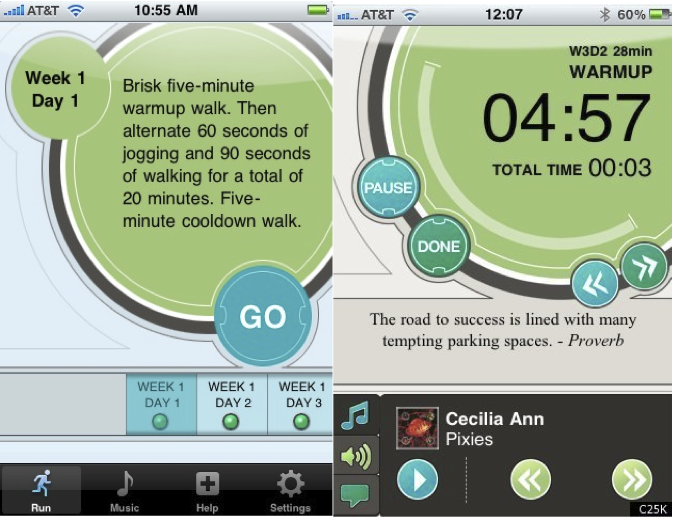
Now couch potatoes really have no excuses. I’ve had numerous friends and clients tell me about this cool app/program. “C25K” gets users off the couch to running a 5k over the course of two months. It has a really high success rate and great reviews because of its slow but structured style. Now just have to figure out how to casually and inoffensively recommend it to your loved ones...

For the kids:
Ok this isn’t only for kids… Who knew destroying fruit could be so much fun? 
What are your favorite healthy apps? What are your favorite apps in general? What do you think a Foodtrainers' app should/would include?